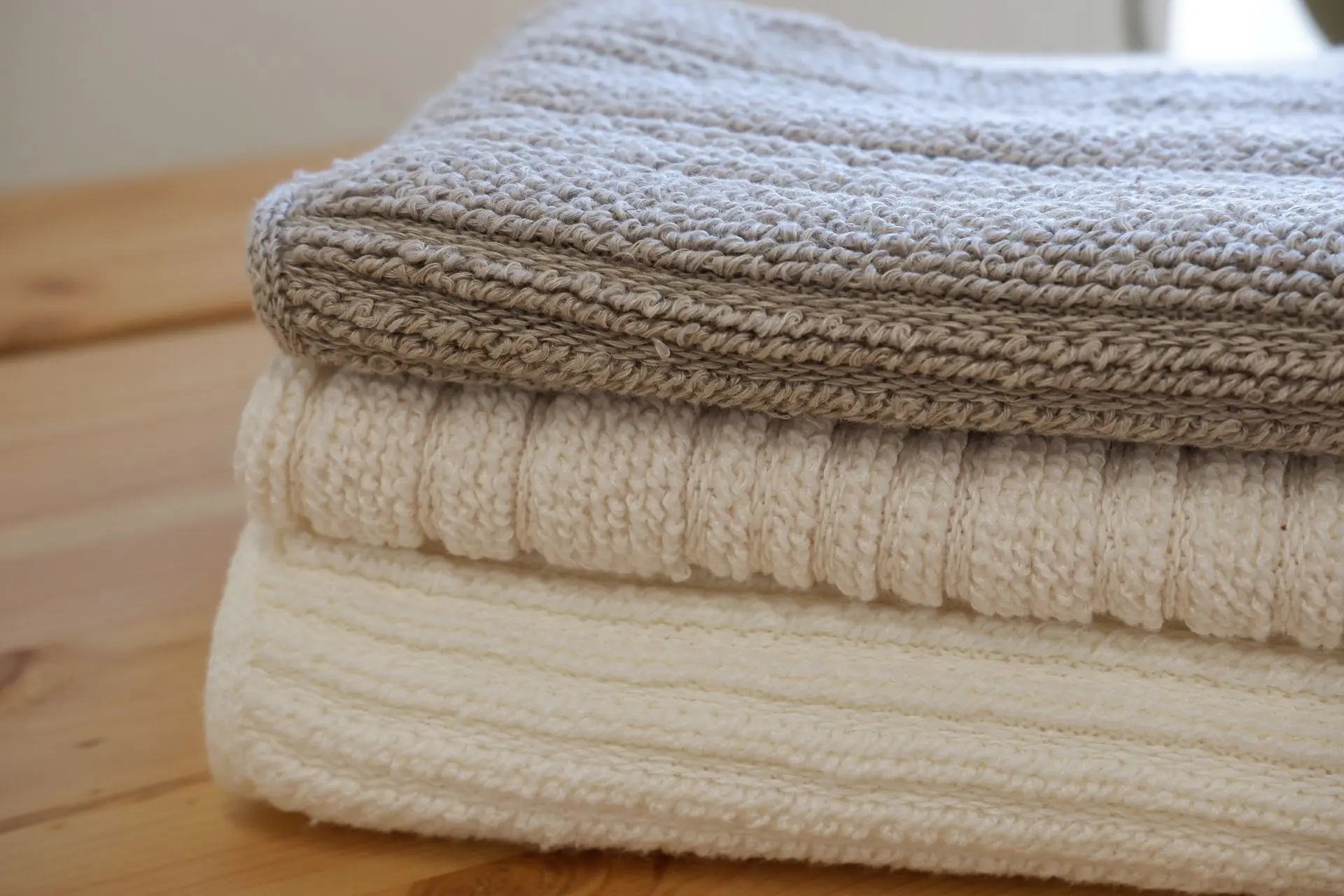
At Design for Resilience; a textile research workshop for a sustainable lifestyle, we have been interested in natural and sustainable materials like linen since 2009. Yes, long before Design for Resilience existed, to be honest.
Vanessa Colignon, founder of Design for Resilience discovered linen during her higher education in fashion design. At the dawn of an environmental awareness, linen emerged as a solution to many problems faced by the textile industry to become ethical, sustainable and desirable. Let’s explore together 5 good reasons to adopt linen throughout your home!
5 good reasons to adopt European linen in your home
1. Linen is suitable for sensitive skin
Linen is a breathable and highly absorbent material that, in addition to its soothing properties, helps avoid repeated friction on the skin that can irritate dry skin.
Moreover, the natural properties of linen protect fragile or atopic skin from dryness, unlike synthetic materials. Meanwhile, the antibacterial characteristics of linen help to protect your skin from irritation. It is, in fact, one of the materials recommended by the St-Luc clinic in Brussels in cases of eczema.
« At Design for Resilience, we do not settle for the first low-cost linen thread available on the market. We work with French and Italian suppliers whose linen from Western Europe is exclusively processed in Europe. But we also ensure to select linen threads that have undergone the least possible transformation; that is why we choose unbleached linen (natural).
Although we could obtain dyed linen with demanding environmental certifications that comply with European standards. We are constantly seeking to source the most sustainable materials available on the market. Recently, we were able to secure an offer for unbleached linen. Unfortunately, we have to order much larger quantities of thread than usual, which represents an investment of €15,000 just for the thread! So, we have launched a fundraising campaign that allows anyone who wishes to support us to pre-order their bath linen from us. This way, we can invest together in this thread, with a lower risk for our business.
It is exclusively thanks to our community and our clientele that we will be able to succeed in relocating eco-responsible materials, sustaining local businesses, and advancing textile research towards greater sustainability! »
Vanessa Colignon
2. Linen can be produced in Europe
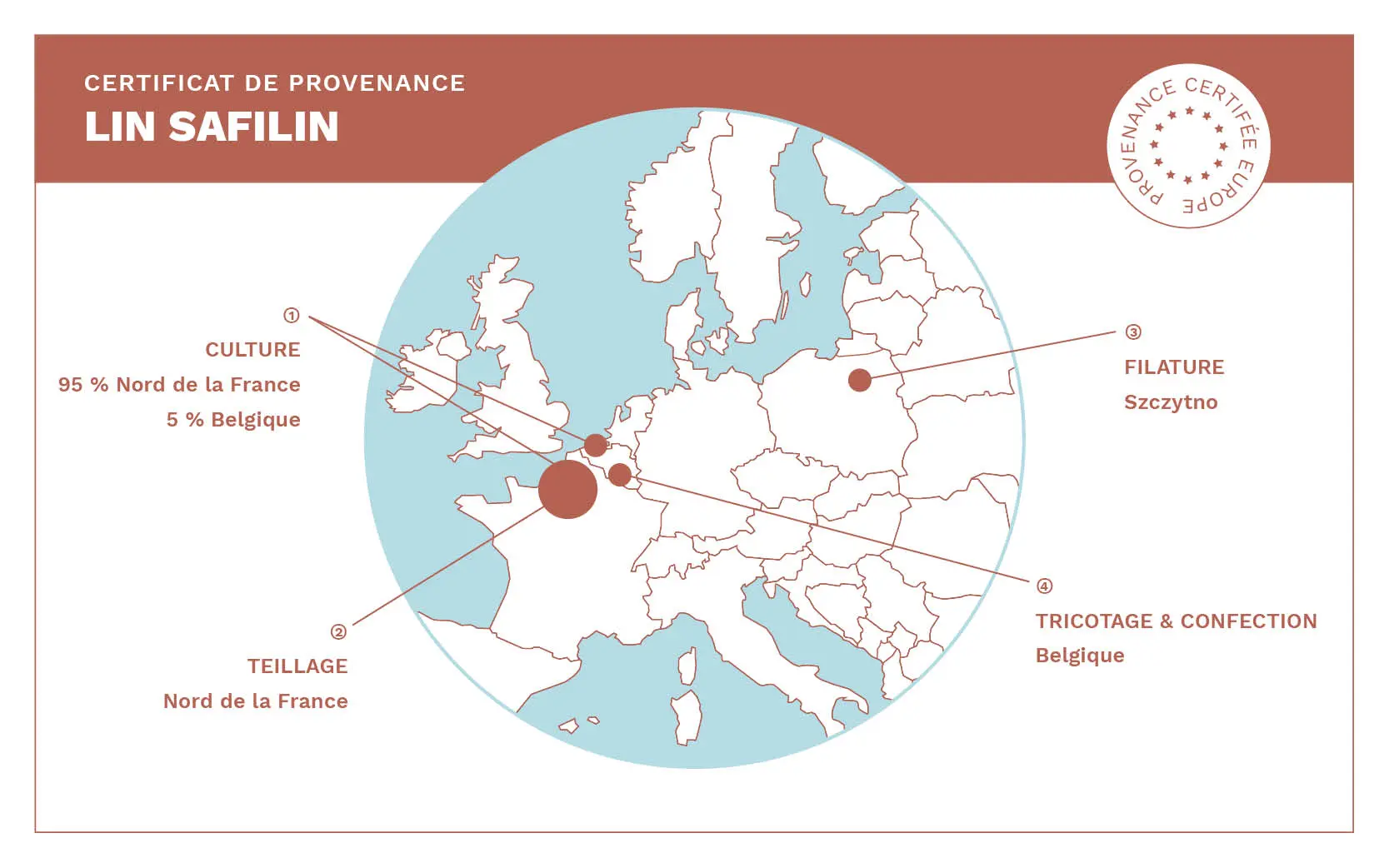
Linen can be grown entirely in Europe and ensure compliance with safety standards for workers and health standards imposed by European regulations REACH.
Although Western Europe, and particularly France, is a leader in global linen production (80%), only 10 to 20% of the linen is actually spun in Europe. The rest goes to Asia or Africa to be transformed into finished products, yarn or fabric…
Sourcing certified Masters of LINEN™ linen, allows us not only to ensure the origin of our fibres, but also to work exclusively with companies that have chosen to preserve the textile linen supply chains in European territory. This is done in respect of strict and committed environmental values; for example, the members of Masters of LINEN™ are committed to using exclusively European and non-GMO seeds. Therefore, using European linen also helps to protect our seed heritage and thus our autonomy.
Sourcing certified European Masters of LINEN™ linen is for us the assurance of rebuilding a production chain that respects REACH standards involving respect for the environment and the health of all; but also ensuring fair wages and healthy working conditions.
3. Linen is more ecological than the majority of other materials
It is a renewable material, with the plant growing in 100 days while capturing CO2. It then transforms in a few weeks, directly re-fertilising the soil with 70% of its composition during its natural extraction in the field.
You will have understood, linen is a material without plastic or synthetic fibre and that is quite good for our health and the fertility of fish; yes, because plastic is responsible for infertility problems in aquatic wildlife and mammals!
Available for pre-order
Discover our European linen bath linen!
4. Linen is more hygienic and naturally odour-resistant
The airy and breathable fibre of linen dries quickly. It is a preferred material in wet areas; such as the bathroom or kitchen. Its fibre is more resistant to unpleasant odours than cotton or microfibre due to its natural properties that slow down the development of bacteria and mould.
An advantage that also allows you to wash your linen much less often than cotton or synthetic fibres! Less laundry; it’s economical, ecological, but it also means less mental load and time spent on household chores.
And don’t be mistaken, if your viscose (rayon, lyocell (Tencel®), bamboo,…) or microfibre linen is said to be “odour-resistant” or “anti-bacterial”; it is not at all due to natural properties, it is due to a biocidal chemical treatment (which kills life) called “finishing” that artificially and temporarily gives bactericidal properties. And quite honestly, these are generally not very nice components for the environment or health. For example, bamboo viscose is made anti-bacterial through the use of quaternary ammonium, a currently controversial substance, whose harmful effects are already proven when it is found in cosmetics. And what about the biodegradability of these materials in the environment? What is their potential toxicity? Let’s not forget that it is a biocide. In the absence of thorough studies on its use in textiles, let’s remain cautious.
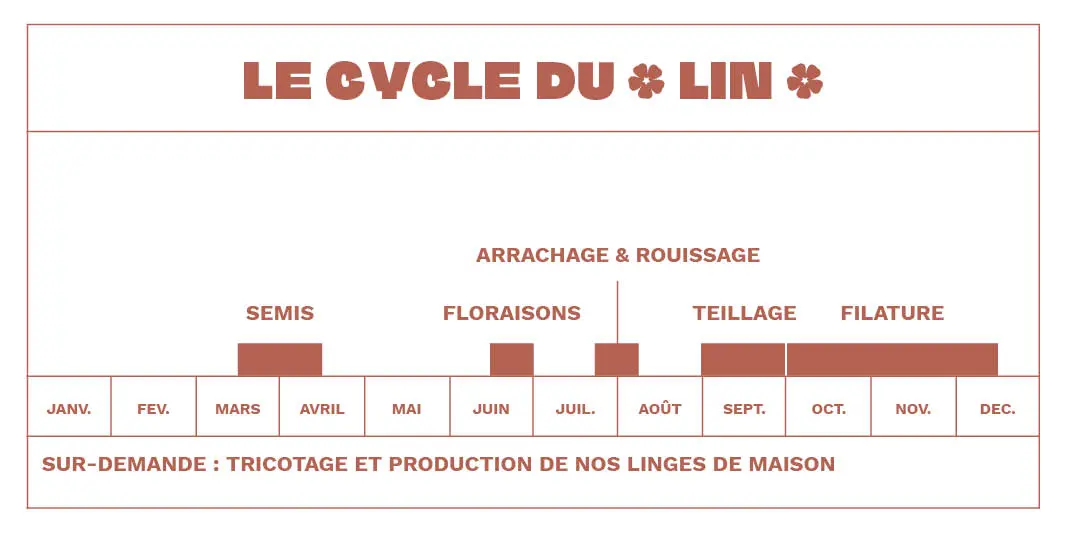
5. Linen is processed naturally and mechanically
After +- 100 days of cultivation, flax flowers, then goes to seed. It is after this stage that the extraction of its textile fibre begins! Its fibre is obtained naturally thanks to the microorganisms living in the soil, which will randomly devour and decompose the bark of the plant directly in the field! #lowtech
During this stage of “controlled rotting”, called retting, the farmer will turn the flax, just as one turns and dries the hay.
After being naturally extracted, the fibres are transformed mechanically: they are then beaten to completely separate them from each other and to soften them, this is scutching. Then come different stages of combing and carding that allow the alignment of all the fibres in the same direction before being sent to spinning.
Each of these stages requires different trades and know-how! In fact, the labour required for the transformation of this type of fibre is 10 times greater than that of cotton, which explains the price difference with conventional materials.
It is a true know-how and a heritage that needs urgent preservation!
All rights Reserved – Design for Resilience 2023