There is plastic in the air
It is raining plastic. This is not a metaphor, it is now our reality: plastics are everywhere and have been found for several decades from the North Pole to the South Pole. As they degrade, their particles spread and end up in the air we breathe, the food we eat and the water we drink, and spread throughout our bodies right into our brains, not without risk to our health.
Every year, the poor management of plastic waste combined with the release of microfibres from textile washing represents a volume of pollution equivalent to 50 billion plastic bottles dumped into the seas and oceans.
But the danger does not only lie in the visible "garbage continents" like the Great Pacific Garbage Patch.
It hides in the invisible: the fragmentation of these materials into microplastics and nanoplastics which now contaminate every link of life, from the water we drink to what we eat, right into our vital organs.

This sponge contains a yellow part made of cellulosic viscose highly absorbent. This polymer does not degrade well in the environment. Although derived from wood chips, the material is no longer natural after processing. The scrubbing part, on the other hand, is made of PET, a plastic that also crumbles with each wash.
Water pollution from our plastic objects.
Why is it imperative to change now? Because the plastic cycle is a dead-end trap. Synthetic fibres (elastane, polyester, polyamide, acrylic, cellulosic viscose), omnipresent in our sponges, our clothing and our household linens, release microplastics throughout their life. Just like all the other plastic or synthetic objects in our daily lives.
The process is overwhelming: once in wastewater, 5 to 10% of these particles escape the filters of treatment plants and are discharged directly into our waterways. Worse still, the remaining 90 to 95%, captured by the plants, become trapped in the sludge. Instead of being eliminated, this sludge is spread on agricultural fields as fertiliser, spreading tonnes of plastic onto our soils and into our food chain.
Globally, according to reports from UN-Water and UNESCO in 2024, only half (52%) of wastewater is treated. In the poorest countries, this figure drops to 8%. This means that for the vast majority of the world's population, microplastics enter waterways without any filtration. Even in equipped countries, no plant is currently capable of filtering all nanoplastics.
At Design for Resilience, we refuse to endorse this system. We have chosen to offer a radical alternative: zero plastic, zero synthetic fibres products, designed to heal the earth rather than poison it. Understanding the scale of the disaster means accepting that change is not negotiable.

What is a microplastic?
Imagine a particle smaller than a grain of rice, sometimes invisible to the naked eye. By definition, any fragment of plastic less than 5 mm is a microplastic. They are divided into two categories :
Primary microplastics : Designed this way from the start (cosmetic microbeads, industrial pellets released into the environment) or released directly through wear (fibres from our synthetic clothing, tyre dust on the roads).
Secondary microplastics : Resulting from the slow fragmentation of larger waste (bottles, bags, nets) under the effect of sunlight and erosion. Once released, they are nearly impossible to eliminate. They persist for centuries, contaminating water, air, and the food chain, from Arctic snows to the abyss.
The oceans of plastic : a tragedy for marine wildlife
These "continents" of waste are not solid islands, but toxic soups suspended in the oceans. For marine wildlife, it is a deadly trap. Turtles confuse bags with jellyfish, birds feed their chicks with bottle caps.
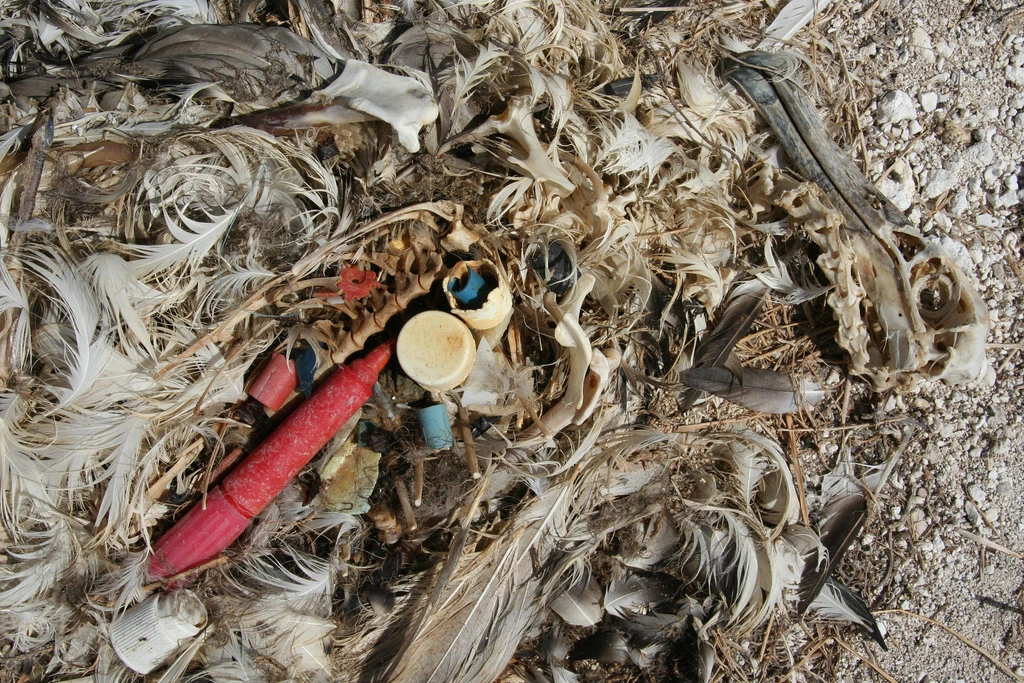
A Laysan albatross, accidentally fed plastic by its parents, found dead in 2006. Source : Wikimedia - Public domain
At the base of the food chain, zooplankton (such as krill and copepods) and filter-feeding animals (mussels, oysters, but also giants like basking sharks and baleen whales) cannot distinguish microplastics from their food. Of similar size and often suspended in the same currents, these particles are ingested en masse, transforming the most essential organisms for marine life into vectors of pollution.
But beyond suffocation, plastic acts as a powerful endocrine disruptor. By fragmenting in aquatic environments, these plastics release toxic components such as PFAS, phthalates, and bisphenol A, recognised as harmful to the fertility of fish and mammals.
Alarming studies, particularly on zebrafish and tilapia, show that these chemical additives act as endocrine disruptors oestrogen-mimicking.
Result : a massive feminisation of populations. Intersex male fish develop ovarian tissues or become sterile, while the ratio of females artificially increases. This imbalance makes reproduction impossible, threatening certain species with local extinction not from fishing, but from infertility. Today, the survival of certain fish species is no longer only compromised by military activities, overfishing, heavy metal pollution, tourism activities, and noise disturbances, but also by plastics that directly interfere with their reproduction. In addition, this pollution contributes to the eutrophication and acidification of the oceans, leading to ocean warming and severely harming the development of corals and aquatic life.
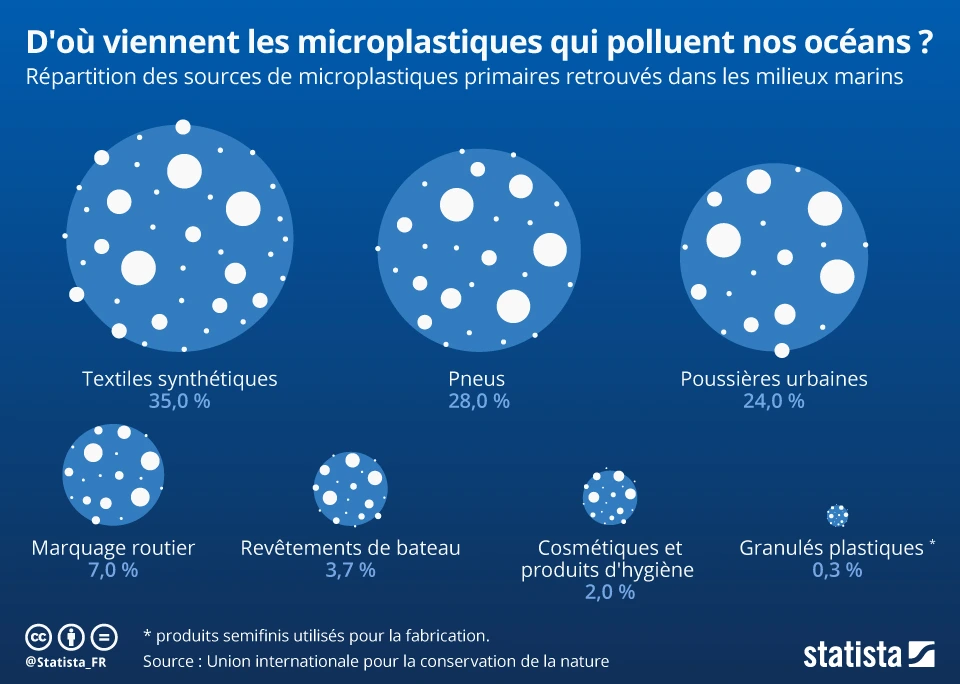
Composition of ocean waste: What is the pollution that saturates our oceans really made of?
If we only look at the direct discharges of microplastics (known as "primary"), the responsibility of our Western lifestyle is overwhelming. According to data from the International Union for Conservation of Nature (IUCN), the world's leading source is textiles: our washing of synthetic clothes releases 35% of the primary microplastics found at sea.
Next is a often forgotten but massive source: tire wear, which alone accounts for 28% of this pollution. With every braking and kilometre travelled, billions of particles of synthetic rubber are washed into the oceans.
The rest of the picture is equally informative: urban dust (24%), road marking (7%), boat coatings (3.7%) and finally cosmetics and hygiene products (2%). Although problematic, the famous industrial plastic pellets (the "mermaid tears") only account for 0.3% of these primary discharges into the oceans, as they are also widely dispersed on land.
This ranking highlights an uncomfortable truth: pollution does not only come from poor waste management, but from the daily use of petrochemical materials. More than 60% of these microplastics come directly from two normalised actions: driving your car and washing your synthetic clothes.

From rain to honey: the omnipresence on our plate
The water cycle has become a vector of contamination. Rain also washes the atmosphere laden with particles and deposits them on our crops.
Examples of contamination cases:
Salt and honey : Microplastics are detected in almost all brands of sea salt and even in honey, reported by bees from polluted environments.
Contaminated crops : Due to the spreading of sewage sludge, our agricultural soils are impregnated with these particles, which then end up in vegetables and cereals. We now ingest plastic at every meal, without seeing it.
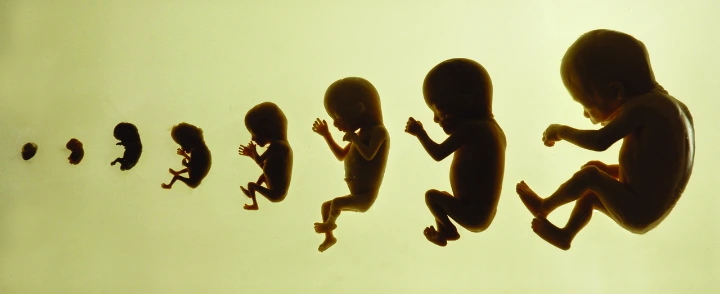
Plastic in our vital organs: A major risk to human health
If plastic disrupts fish reproduction, what about us? Nanoplastics, due to their tiny size, cross biological barriers. They have been found in the lungs, liver, kidneys, atheromatous plaques obstructing the coronary arteries, testicles, placenta, but also directly in the amniotic fluid in which embryos are bathed and in the meconium (the first stools) of newborns, proving active contamination from intrauterine life.
More worrying, their ability to cross the blood-brain barrier raises serious hypotheses about their involvement in neurological inflammation and the development of neurodegenerative diseases such as dementias. Plastic not only pollutes the environment; just like certain pesticides, it attacks our cognitive and reproductive integrity. It is said to be neurotoxic and reprotoxic.
One might wonder if the kings of oil did not ingest too much plastic when they were small to impose such denial and such a health burden on us...
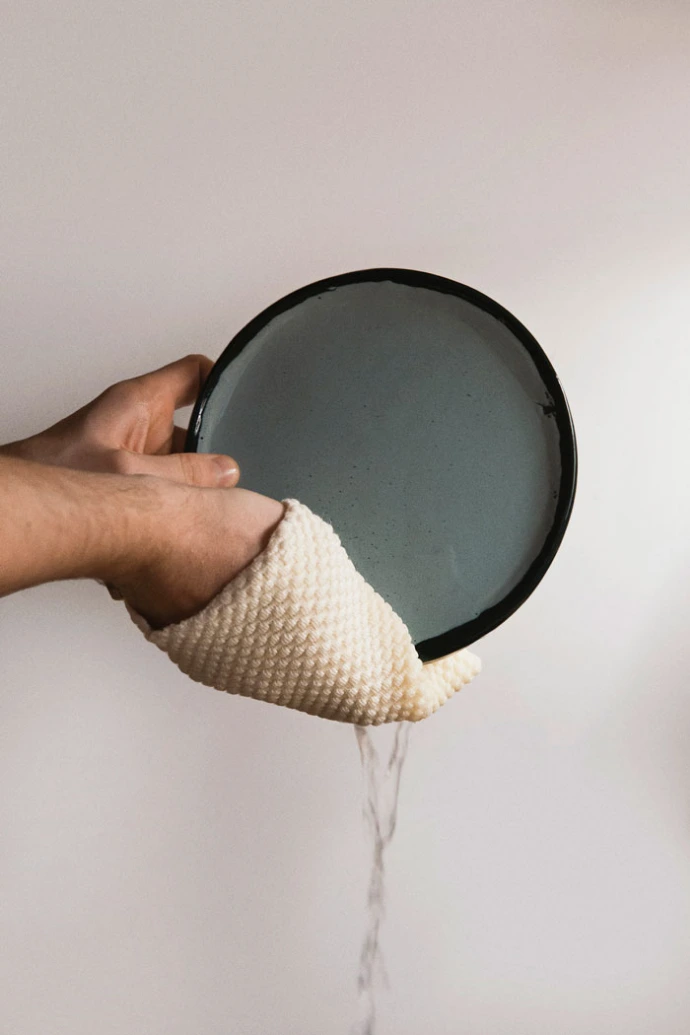
Solutions exist thanks to natural fibres: hygiene, absorption and resilience
In the face of this urgency, returning to certain natural materials and modernised techniques is a necessary leap forward for the preservation of everyone's health. At Design for Resilience, our raw materials (linen, hemp, wool) are not only ecological, they are technically superior to plastic in many uses.
Impeccable hygiene : Thanks to the natural antibacterial and antifungal properties of linen and hemp, our sponges and textiles have superior resistance to the development of microorganisms (bacteria,...) and wear. Unlike synthetic sponges that become breeding grounds for bacteria, our products can be used for a week without washing and remain clean for between 7 and 12 weeks thanks to their properties, or even longer if you follow our recommendations.
Unmatched absorption : Linen can absorb 20% of its weight in water, making it, after wool, one of the most absorbent natural materials. Our tests confirm that our cloths dry surfaces faster than any microfiber or synthetic sponge, while retaining soap longer.
A positive impact : By choosing these materials, you preserve the natural environments on which populations, wildlife, and flora are interdependent. You also contribute to maintaining local jobs in Belgium and Europe, supporting a real and ethical economy.
The best waste is the one that does not exist
Acting concretely in your daily life
Resistance and resilience start in your kitchen and bathroom :
Ban synthetic and viscose : Replace sponges, clothes and wipes made of polyester or viscose preferably with hemp and linen or certified organic GOTS cotton or ethical wool or ramie (Asian nettle).
Adopt solid wood : Reject plastic cutting boards that micro-scratch and release particles into your food. Similarly for your health, forget bamboo kitchen boards glued with harmful adhesives. Opt for durable solid wood, and above all: take care of it to make it last for decades.
Utensils and healthy cooking : Ban plastic utensils (especially black ones) that release toxins when heated. Replace them with wood or stainless steel. Say goodbye to PTFE (Teflon) pans that degrade into toxic fluorinated polymers. Prefer raw cast iron, enamelled iron, or stainless steel. For scrubbing, use washable stainless steel sponges, baking soda, and the action of heat, wooden brushes, or our hemp sponges.
Dress naturally : Prefer linen, wool, fair trade organic cotton, and hemp to prevent each wash from polluting the oceans with microfibres. Some natural technical fabrics offer a high-performance ecological alternative for waterproofing. The major advantage of these traditional materials is that they provide durable protection without resorting to PFAS or toxic plasticisers often found in modern synthetic membranes. Contact us for a quote or an order of custom natural and sustainable clothing.
And for technical pieces like rain jackets, prefer companies certified by the Fairwear Foundation and pieces guaranteed free from PFAS and other polluting plasticisers. You can also pay attention to the quality of recycled synthetic fibres where applicable: a long, strong recycled filament is better than thousands of short microfibres that will spread throughout the environment.
Change your habits : Opt for intermodality whenever possible in terms of time and health. This journey takes 30 minutes by car, but 45 minutes by bike? It might be an opportunity to consider those 2 x 15 extra minutes and the travel time you would have spent sitting and passive in the car as your daily or weekly workout and awakening session. What could be better than a fresh and well-awake brain after a bike ride to start the day?
Support your local, regional or European elected representatives and NGOs advocating for waste and plastic reduction : Sign and share petitions calling for the cessation of the production of toxic substances, support them, share, talk about it to make changes at the European level and give courage and support to the MPs and elected representatives who can make a difference.
Radically refuse single-use items : It cannot be repeated enough but the best waste is the one that does not exist. In many cases, get into the habit of always having washable cutlery with you, a stainless steel water bottle and why not a washable napkin?
Be kind to yourself : Do not beat yourself up if you happen to forget them or if you haven't had time to wash your water bottle, etc.: everyone has their own pace and we are not all equal in energy, health and available time. The important thing is to face reality and act consciously whenever we are able and to set an example.

To inform, mobilise and organise to limit plastic
In the face of this grim observation, inspiring initiatives are emerging to clean up and take action.
Clean up the existing : The young engineer Boyan Slat (1994), founder of the NGO The Ocean Cleanup, who aims to eliminate plastic pollution from the oceans by 2050, has developed innovative systems to collect plastics in rivers and in the Great Pacific Garbage Patch. Although promising, these technologies will never be able to suck up invisible microplastics: prevention remains the only sustainable solution.
Kimchi, our saviour ? Although promising research avenues, notably a 2025 study reported by ScienceDaily, suggest that certain probiotic bacteria from kimchi could bind to microplastics in the intestine and promote their excretion, these mechanisms remain to be confirmed in humans and do not constitute a miracle cure. It is crucial to remember that this potential approach cannot eliminate the pollution already accumulated in our vital organs. Therefore, the most effective and safest solution remains above all prevention: drastically reducing our exposure by avoiding products packaged in plastic or likely to be contaminated. Only reducing at the source of our plastic consumption can sustainably protect our health, well beyond hopes based on an experimental "detox" diet.
To mobilise locally and politically :
The Bridge ASBL : Co-founded by Adélaïde Charlier, Chloé Mikolajczak, Lucie Morauw and Laurie Pazienza. This Belgian organisation, which received the Amnesty Youth Human Rights Award in February 2026, plays a crucial role in "citizen lobbying". It acts as a bridge between civil society and political decision-makers to push for the adoption of an ambitious global treaty on plastic pollution. Their work involves advocating for binding laws that reduce plastic production at the source, rather than simply managing waste, and regularly collaborates with actors like Camille Étienne, who has played an important role in raising public awareness about PFAS pollution. You can concretely help The Bridge asbl by making a donation.
Consom'Action : This Belgian network of professionals and citizens actively promotes responsible consumption and zero waste. They support businesses in implementing bulk systems and raise public awareness about reducing single-use packaging. Their concrete action helps to structure a viable economic alternative to "all plastic". Design for Resilience is a member of Consom'Action.
Surfrider Foundation Europe : Known for its large beach and ocean clean-up campaigns, this NGO also fights legally and politically against polluters and for the protection of aquatic ecosystems.
However, let us never forget this fundamental reality that must be viewed on a human scale: no cleaning or recycling technology, nor any bacteria or fungus will replace source reduction. The absolute priority remains to remove single-use plastics and materials that fragment instead of biodegrading from our daily lives.
At Design for Resilience, we do not simply sell you objects. We offer you a massive construction weapon against pollution. Choosing our products means refusing to let plastic become the future of our children. It is choosing a world where technology imitates the wisdom of nature.
The future will not be plastic. It will be wild, living, and resilient.
Detailed sources and references
Definition and generalities: Surfrider Foundation - Microplastics
Wastewater treatment: UN-Water & UNESCO - Global Report 2024
Sources of pollution (IUCN figures): IUCN - Primary Microplastics in the Oceans and Statista - Microplastic sources breakdown
Impact on wildlife (Feminisation): Studies on zebrafish and tilapia (PMC, Journal of Hazardous Materials).
Presence in human organs: Study on nanoplastics in the brain and organs (Nature/PubMed)
Kimchi and plastic excretion: Study published in Nature Nanotechnology (reported by ScienceDaily) - Confirms the action of adsorption and intestinal excretion, no total degradation.
Ocean cleanup: The Ocean Cleanup - Boyan Slat
Political advocacy: The Bridge ASBL - Mission and Plastic Treaty
Responsible consumption: Consom'Action - Zero Waste Network
Internal data Design for Resilience: Absorption tests and hygienic properties of linen/hemp.
3M and PFAS scandal in Flanders: Le Monde - "Excavating soil, changing lake water... PFAS contaminated Flanders"
Trial and responsibility 3M: RTBF - "PFAS: the trial of 1400 residents of Zwijndrecht against 3M"
Report on the management of PFAS in Belgium: OECD - Belgium PFAS Country Information
Greenpeace Belgium: Two years after the PFAS scandal, where do we stand?