Introduction to textile flax
The origins of flax
The earliest traces of flax cultivation date back to around 10,000 to 8,000 years BC, mainly in the Near East (the Fertile Crescent region, particularly in Turkey and Syria). Charred flax seeds and woven fibres have been discovered at Neolithic sites, such as Çayönü (Turkey) and Djeitun (Turkmenistan).
Flax was cultivated for its textile fibres (for linen, a very fine fabric) and its seeds (a source of oil and food). It is considered one of the first plants domesticated by humans, even before hemp in some regions.
In Europe, its cultivation developed as early as the 6th millennium BC, particularly in the Balkans and Central Europe. In ancient Egypt, flax was already widely used for the burial wrappings of mummies and clothing as early as 5,000 BC.
Flax is therefore older than hemp in terms of domestication and certain archaeological evidence.
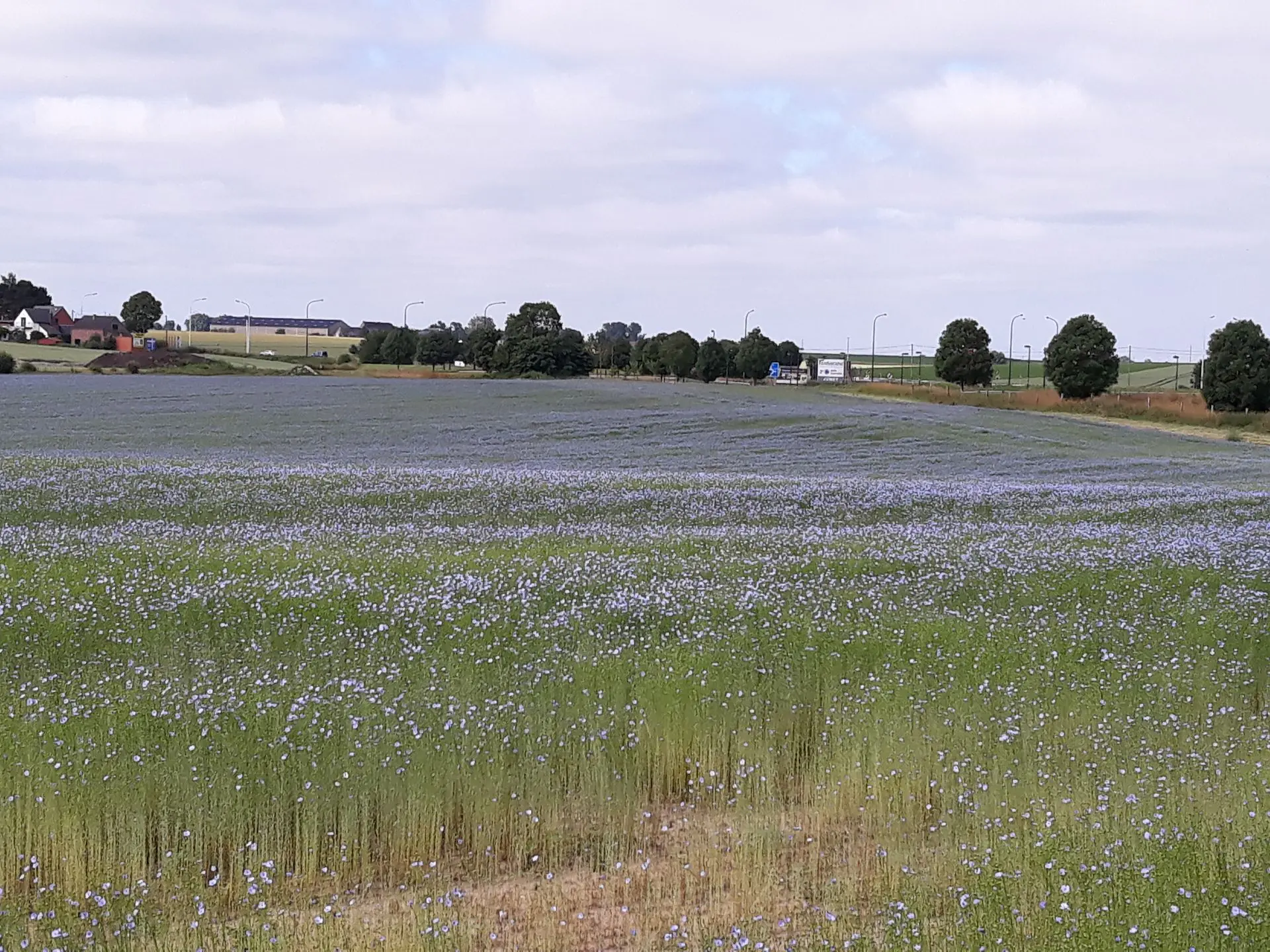
Flax cultivation in the agricultural countryside of Northern Charleroi, Belgium ©Colignon Vanessa - 2018
Flax cultivation in Europe, today
In Europe, flax cultivation mainly occurs from the south of Holland to the north of France, passing through Belgium.
This area benefits from an ideal oceanic climate (alternation of rain and sunshine) necessary for retting. France is the world's leading producer, followed by Belgium and the Netherlands.
Without irrigation, it requires very little, if any, pesticide. These are only applied in a reasoned manner (in the case of excessive attack on crops) and are obtained solely through natural and mechanical transformations : retting and scutching.
Historically, the processing of flax has heavily impacted aquatic ecosystems. Until the mid-20th century (and sometimes until the 1940s-50s depending on the regions), immersion retting in rivers and basins caused a critical depletion of oxygen, leading to massive fish mortality. Contemporary writings also report numerous poisonings of wild and domestic animals coming to drink from these retting ponds : these bodies of water where large quantities of flax bundles were soaked.

Retting pond (body of water used for retting flax) at Fontaine la Louvet (Eure).
Source : Wikimedia 2009 Codepem
In light of this heavy ecological toll, this process has been gradually abandoned in favour of field retting (or "on land"). Although this natural method requires several weeks of patience and particular attention to weather conditions, it has become widespread to preserve water quality and improve that of the fibre.
In the 80s and 90s, while European standards were evolving in favour of the environment and the health of workers, many companies chose to massively relocate their production to Asia and Eastern Europe. Motivated by the lure of profit from a low-cost workforce, devoid of social and legal protections, these industries also sought to escape the new ecological constraints. Thus, spinning (the transformation of fibre into yarn), a key link in the chain, almost disappeared from our territories to concentrate in China, where the regulations were less strict.
Today, although still improvable, European standards are among the most demanding in the world. This rigor displeases certain polluting industries and creates heavy pressures in the European Parliament, particularly through so-called "omnibus" bills that threaten recent achievements such as the REACH standards or the duty of vigilance of companies.
In the face of this haemorrhage of skills, some organisations have decided to resist. By committing to produce ethically and locally, they have given birth to the Masters of LINEN™ label.
Managed by the European Confederation of Linen and Hemp (CELC), this label guarantees total traceability: from the seed (non-GMO and european) to the finished product, all steps are carried out in Europe. A guarantee of 100% European origin that supports a movement of relocalisation that is still timid, but very real, of spinning on our continent.
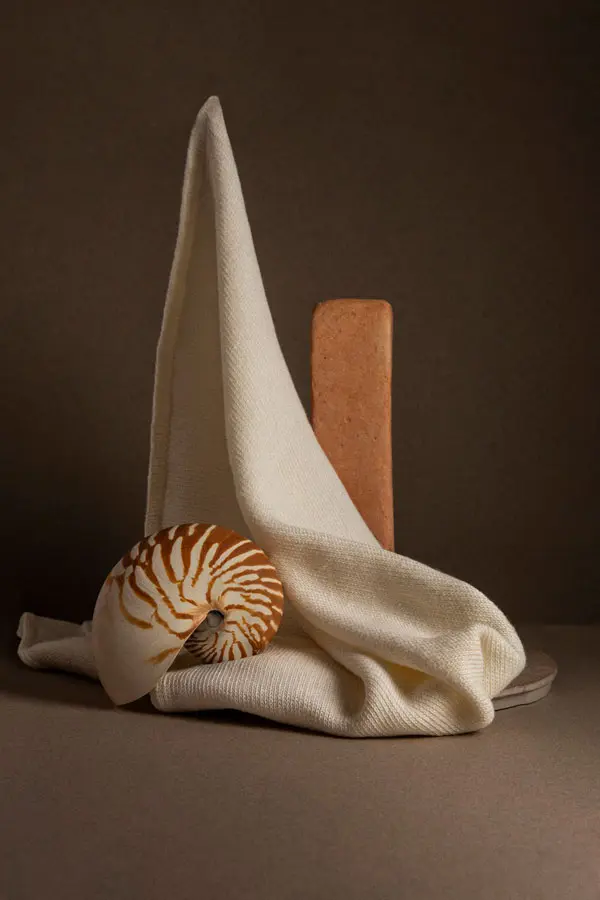
The Minimalist : European linen bath towel, developed by our studio in 2020 and knitted in Belgium
Retting: the invisible work of microorganisms
The microorganisms are microscopic living beings present in the air and in the soils. Bacteria, microalgae, and many fungi such as yeasts are part of the microorganisms.
It is thanks to their detritivorous action, combined with summer temperatures, morning dew, and the work of farmers (flax growers) who regularly turn the flax windrows to ensure even and controlled drying and degradation, that we obtain the first phase of flax fibre extraction. This same process is also used for the fibre of hemp which also has fibres around the wood of its stem.
The retting of flax is an exclusively natural transformation step. This is what differentiates natural origin fibres from artificial or synthetic origin fibres, which require chemical transformations to be obtained (viscose, rayon, polyester, elastane, acrylic,...)
After pulling the flax, the flax growers align the plants horizontally on the ground, in order to expose them to the sun.
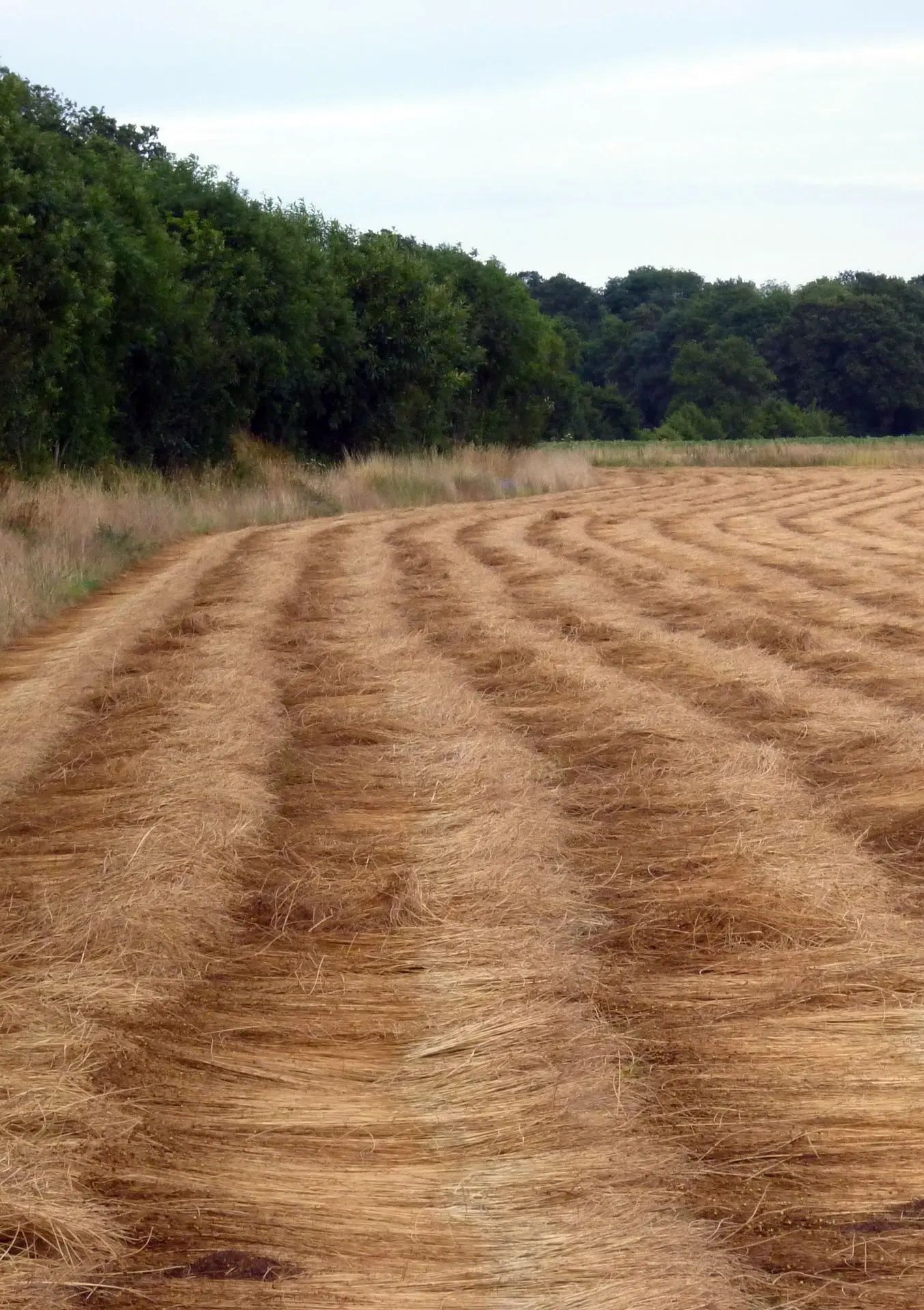
Flax retting in fields by dew in Morsan (Eure). (Wikimedia)
It is at this moment that the soil microorganisms come into play! They then develop on the plants and devour the pectin, the natural cement of the plant that holds the cellulosic fibres together.
This action of controlled decomposition will therefore release the fibres naturally present in the plant, it is retting.
In other words, retting involves allowing fibre plants to rot on the ground, while controlling the process in order to obtain and maintain strong fibres. A process as frugal as growing its own plant, addressing current environmental challenges, compared to the resources needed for the production of cotton, synthetic fibres or even viscose, such as that from bamboo which also significantly contributes to deforestation..
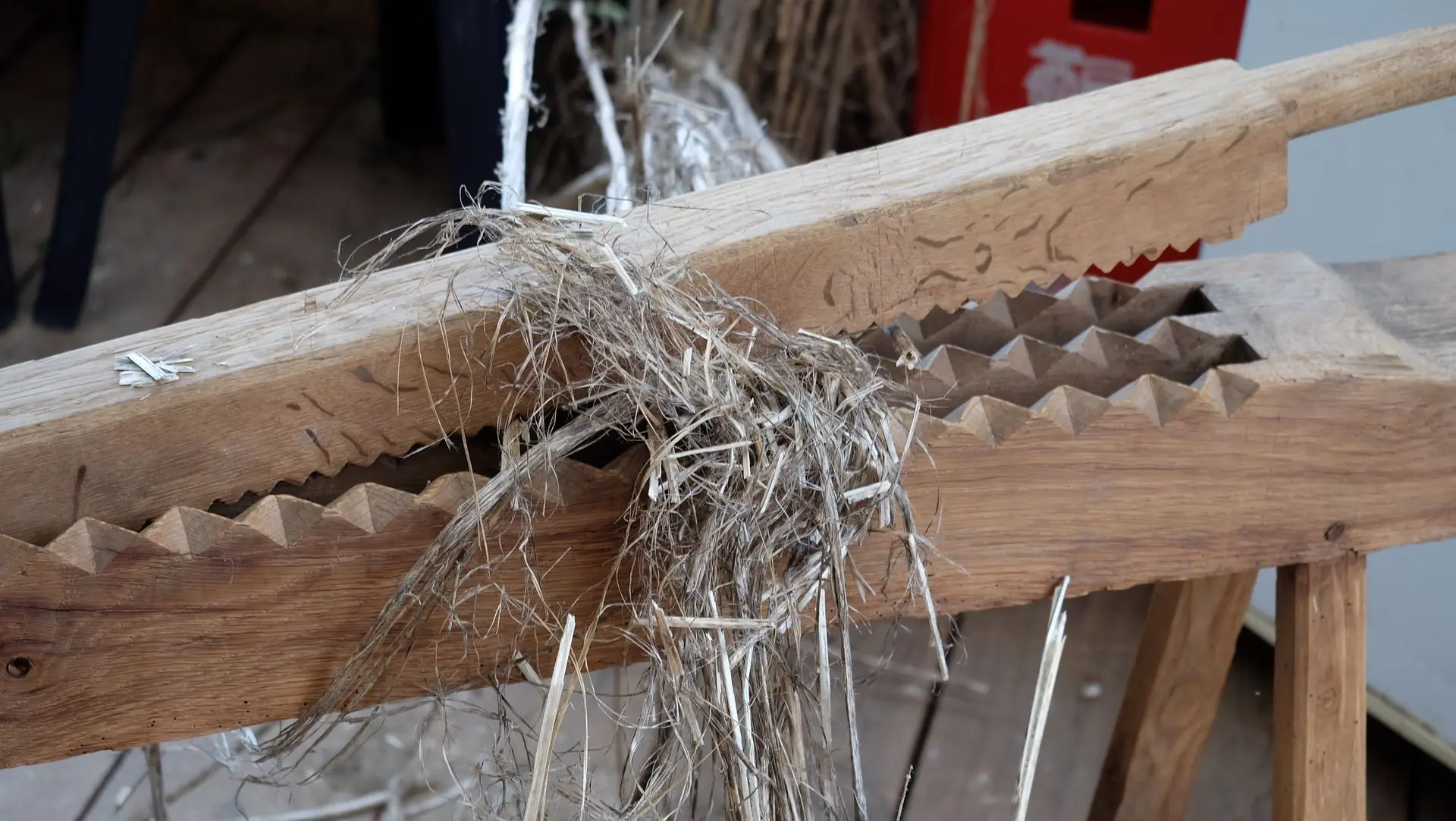
Manual scutching
Flax scutching: releasing the fibre for spinning
Once the retting is complete, the flax straw is ready for scutching, the first industrial step in its transformation. This 100% mechanical operation involves crushing and beating the dried stems to break the central woody part (the "hurds" for hemp or "anas" for flax) without damaging the external textile fibres.
This process physically separates the long fibre (the "tow", noble and silky) from the straw and the short fibres (the "tow").

Flax tow after scutching and before carding - Claude Truong-Ngoc - Wikimedia Commons - 2015
Scutching is crucial as it prepares the raw material for the next step, combing, which will align the fibres before their transformation into yarn during spinning.
Today carried out in specialised factories (scutching), this process also valorises the by-products: the anas (and the hurds) is used for animal bedding, insulation or agronomy, making flax a zero-waste plant.
Visit to a flax processing unit in France
The incredible technical properties of flax
If you have ever used flax, you may have wondered: how could we abandon such a high-quality and effective material?
The answer is simple: wars, economic crises, and industrial lobbies. While we will not dwell today on the history of the decline of flax, we offer you a focus on its incredible technical properties. Natural advantages that will ultimately convince you to adopt it, if you haven't already!
Natural thermoregulator:
- Flax is an effective thermal insulator. Its hollow structure and high thermal conductivity allow it to reflect body heat in summer (immediate cooling effect on touch) and retain heat in winter. It is a "all-season" fabric.
Ultra-absorbent, breathable, and quick-drying (Hygroscopic):
- Flax can absorb up to 20% of its weight in moisture without appearing wet.
- It quickly wicks sweat out to the surface of the fabric where it evaporates. This "breathing" ability makes the fabric dry in record time, much faster than cotton.
Antibacterial and antifungal (Anti-odour):
- The smooth structure of flax fibre and its ability to stay dry prevent bacteria and fungi from developing.
Direct consequence : Flax retains much less bad odours than synthetic fibres or even cotton. It therefore requires fewer frequent washes, which prolongs its lifespan and reduces the ecological impact.
Strong and durable (The strongest of natural fibres):
- Linen is the most durable natural textile fibre (about 2 to 3 times stronger than cotton). It withstands frequent washing very well, even at high temperatures, and does not pill (does not form "bobbles").
- It improves with age: Unlike other fabrics that wear out, linen becomes softer, smoother and shinier with each wash while retaining its strength. It is often said that a beautiful linen cloth is passed down from generation to generation.
Hypoallergenic and healthy:
- It is a natural fibre, untreated chemically (especially if certified), that does not irritate the skin. It is ideal for sensitive skin, babies and allergic individuals.
Stain resistant:
- Thanks to its smooth and low-pile surface, dirt adheres less well than on cotton. Stains often come out more easily in the wash.
Note : Raw linen can be sensitive to immediate grease stains, but once washed, it is very easy to care for.
Anti-static:
- Linen accumulates very little static electricity, unlike synthetic fibres. It therefore attracts less dust and airborne particles.
Discover 5 reasons to adopt linen for your bath linen
Traceability of linen in Europe and organic linen
The "Masters of LINEN" label guarantees 100% European linen
As mentioned above, this label, managed by the CELC (European Confederation of Linen and Hemp), guarantees 100% European traceability, from seed to finished product, without GMOs and in compliance with European social and environmental standards.All our linen threads and linen fabrics have this label.
Fully traceable linen exists
Recently, one of our producers developed a range of fully traceable linen thread. This comes with a certificate detailing each of the transformation steps in Europe. While we are pleased about this, for now, this range of thread is only available in significant minimum purchase quantities that are not yet accessible to us. Therefore, this remains one of our goals to achieve!
Organic linen also exists in Europe
This time, it is not the budget that works against us, but the monopoly. Yes, we simply do not have access to the organic linen available on the market. Why? Be careful, here we are indeed talking about the thread. This is reserved each year by larger clients. We simply cannot compete at our scale. Who knows, maybe one day thanks to you?
Sources :
- Wikipedia – Linen (plant)
- Terres Inovia – History of linen
- INRAE – History of textile crops
- Louvre Museum – Ancient textiles
- British Museum – Linen in ancient Egypt
- Safilin,
- USRTL (Scientific and Technical Union of Linen),
- Ministry of Culture (PCI Sheets).
Let’s create the eco-responsible clothing of tomorrow together
Now, close your eyes and imagine what could be achieved with this material in terms of eco-responsible clothing…
Would you like to dress in Belgian and European linen? Our textile research workshop develops natural, Belgian, and ecological clothing!
Participate in the development of eco-friendly clothing, order your custom garment now.
Adopt your first ultra-absorbent linen towel
Beyond linen: choose your materials consciously
Linen, wool or viscose? Dive into our analyses to distinguish the virtuous fibres from those to avoid for the planet.